# sip.conf config file update
### [Instructional Video](https://www.youtube.com/watch?v=rtHFdhCm434)
### Specification
[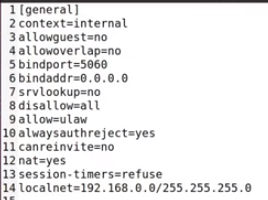](https://bsa.lynops.com/uploads/images/gallery/2024-03/E5kimage.png)
##
- [ ] **allowguest=no** - this setting determines if anonymous callers are permitted to place calls to Asterisk. This defaults to ‘yes’.
- [ ] **allowoverlap=no** - limits the time between digits when dialing with the system
- [ ] **bindport=5060** - 5060 is the default
- [ ] **bindaddr=0.0.0.0 -** this is the default IP address to listen on (all network interfaces)
- [ ] **srvlookup=no** - default is yes
- [ ] **disallow=all** - disallows codecs
- [ ] **allow=ulaw** - allow codecs in order of preference
- [ ] **alwaysauthreject=yes** - rejects bad authentication requests on valid usernames, deny remote attackers the ability to detect existing extensions with brut-force
- [ ] **canreinvite=no** - ? default is yes.
- [ ] **nat = yes** - ? default is no
- [ ] **session-timers=refuse** - stops session timers from ending calls
- [ ] **localnet=69.209.19.198** - needs to be the IP address range we have in your network.
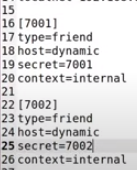
### Device Settings
[](https://bsa.lynops.com/uploads/images/gallery/2024-03/FR2image.png)
### SIP Configuration – general
The \[general\] section of sip.conf includes the following variables:
- **allowsubscribe** = yes|no : Allow or Ignore Subscribe requests
- **[allow](https://www.voip-info.org/asterisk-codecs-allow/ "Asterisk codecs allow")** = <codec> : Allow codecs in order of preference (Use DISALLOW=ALL first, before allowing other codecs)
- **[disallow](https://www.voip-info.org/asterisk-codecs-allow/ "Asterisk codecs allow")** = all : Disallow all codecs (global configuration)
- *A codec is **a hardware- or software-based process that compresses and decompresses large amounts of data**.*
- **[allowexternaldomains](https://www.voip-info.org/ "Create the page: Asterisk sip allowexternaldomains")** = yes|no : Enable/Disable INVITE and REFER to non-local domains. Default **yes**. (New in v1.2.x).
- **[allowguest](https://www.voip-info.org/asterisk-sip-allowguest/ "Asterisk sip allowguest")** = yes|no : Allow or reject guest calls. Default is **yes**. (this can also be set to ‘osp’ if asterisk was compiled with OSP support). (New in v1.2.x).
- **[allowoverlap](https://www.voip-info.org/ "Create the page: Asterisk sip allowoverlap")** = yes|no : Enable/disable overlap dialing support. Default **yes** (Overlap dial provides for a longer time-out period between digits, also called the inter-digit timer. With overlap dial set to off, the gateway expects to receive the digits one right after the other coming in to this line with very little delay between digits. With overlap dial set to on, then the device waits up to about 2 seconds between digits).
- *Set “**alwaysauthreject=yes**” in your sip.conf file. This option has been around for a while (since 1.2?) but the default is “no”, which allows extension information leakage. Setting this to “yes” will reject bad authentication requests on valid usernames with the same rejection information as with invalid usernames, denying remote attackers the ability to detect existing extensions with brute-force guessing attacks.*
- *Customers started to complain that Incoming calls were dropping after 15mins exactly and Outgoing calls were dropping after 30mins… I took a look into the problem and correcly so… they were!*
*After loads of digging around the Trunk Settings, calling up the SIP provider (GammaTelecoms) blaming them… I found a setting from running the command from the Asterisk Debug “asterisk -rvvv” sip show settings > Global Signaling Settings:*
***Session Timers**: Accept*
*Session Expires: 1800 (30mins)*
- **[autocreatepeer](https://www.voip-info.org/asterisk-sip-autocreatepeer/ "Asterisk sip autocreatepeer")** = yes|no : If set, anyone will be able to log in as a peer (with no check of credentials; useful for operation with SER). Default **no**.
- **[autodomain](https://www.voip-info.org/ "Create the page: Asterisk sip autodomain")** = yes|no : Enable/disable Asterisk’s ability to add local hostnames and local IP address to the [domain](https://www.voip-info.org/asterisk-sip-domain/ "Asterisk sip domain") list. externip or externhost are also taken into the [domain](https://www.voip-info.org/asterisk-sip-domain/ "Asterisk sip domain") list. Default **no**. (New in v1.2.x).
- **bindaddr** = IP\_Address : IP Address to bind to (listen on). Default **0.0.0.0** (all network interfaces).
- *binds to all network interfaces on the current computer (instead of just localhost - 127.0.0.1 or the hostname),*
- *Using `0.0.0.0` will only bind to IPv4-enabled interfaces. However, if you bind to `::`, that should cover all IPv4 and IPv6 interfaces, assuming your TCP/IP stack (and Java) have IPv4-compatible IPv6 sockets enabled.*
- **bindport** = Number : UDP Port to bind to (listen on). Used to be **port** in Asterisk v1.0.x. Default **5060**.
- *Unlike the TCP ports, UDP ports do not need to establish connections before transferring data.*
- **callerid** = <string> : Caller ID information used when nothing else is available. Defaults to **asterisk**. (The ability to override the default appears to available in Asterisk 1.0.9. Unsure about other versions.)
- **[canreinvite](https://www.voip-info.org/asterisk-sip-canreinvite/ "Asterisk sip canreinvite")** = update|yes|no|nonat (global setting): For some reason this defaults to **yes**, so beware…
- **[checkmwi](https://www.voip-info.org/ "Create the page: Asterisk sip checkmwi")** = Number : Global interval (in seconds) between mailbox checks. Default **10** seconds. (New in v1.2.x)
- **[compactheaders](https://www.voip-info.org/ "Create the page: Asterisk sip compactheaders")** = yes|no : Indicates Asterisk should send compact (i.e. abbreviated) headers in the SIP messages. Default **no**. (New in v1.2.x)
- **context** = <contextname> : This is the default [context](https://www.voip-info.org/asterisk-contexts/ "Asterisk contexts") and is used when a endpoint has no [context](https://www.voip-info.org/asterisk-contexts/ "Asterisk contexts") property. The [context](https://www.voip-info.org/asterisk-contexts/ "Asterisk contexts") in section of an endpoint is used to route calls **from** that endpoint **to** the wanted destination. The [context](https://www.voip-info.org/asterisk-contexts/ "Asterisk contexts") body is located in extensions.conf.
- **defaultexpiry**= Number : Default duration (in seconds) of incoming/outgoing registration. Default **120** seconds.
- **[domain](https://www.voip-info.org/asterisk-sip-domain/ "Asterisk sip domain")** = domains : Comma separated list of domains which Asterisk is responsible for. (New in Asterisk 1.2.x)
- **[dtmfmode](https://www.voip-info.org/asterisk-sip-dtmfmode/ "Asterisk sip dtmfmode")** = inband|info|rfc2833 (global setting). Default **rfc2833**. **Warning:** inband very high CPU load.
- **dumphistory** = yes|no : Enable support for dumping of SIP conversation’s transaction history to LOG\_DEBUG. Default **no**. (New in v1.2.x)
- **[externip](https://www.voip-info.org/asterisk-sip-externip/ "Asterisk SIP externip")** = IP\_Address or a hostname : Address that we’re going to put in SIP messages if we’re behind a NAT. If a hostname is used as the value, then the IP address associated with the hostname is looked up only once during the reading of the sip.conf. If you want support for a hostname associated with a dynamic IP address, use [externhost](https://www.voip-info.org/ "Create the page: Asterisk sip externhost").
- **externhost** = hostname.tld : (New in Asterisk 1.2.x)
- **externrefresh** = Number : Specify how often (in seconds) a hostname DNS lookup should be performed for the value entered in ‘externhost’. Default **10** seconds. (New in Asterisk 1.2.x).
- **fromdomain** = <domain> : Sets default **From:** domain in SIP messages when acting as a SIP UAC (client)
- **ignoreregexpire** = yes|no : Indicates whether to use Contact information about a peer even if the information is stale because it has reached its expiration time. Default **no**. (New in v1.2.x)
- **jbenable** = yes|no : Enables the use of a jitterbuffer on the receiving side of a SIP channel. (Added in Version 1.4)
- **jbforce** = yes|no : Forces the use of a jitterbuffer on the receive side of a SIP channel. Defaults to “no”. (Added in Version 1.4)
- **jbmaxsize** = Number : Max length of the jitterbuffer in milliseconds. (Added in Version 1.4)
- **jbresyncthreshold** = Number : Jump in the frame timestamps over which the jitterbuffer is resynchronized. Useful to improve the quality of the voice, with big jumps in/broken timestamps, usually sent from exotic devices and programs. Defaults to 1000. (Added in Version 1.4)
- **jbimpl** = fixed|adaptive: Jitterbuffer implementation, used on the receiving side of a SIP channel. Two implementations are currently available – “fixed” (with size always equals to jbmaxsize) and “adaptive” (with variable size, actually the new jb of IAX2). Defaults to fixed. (Added in Version 1.4)
- **jblog** = no|yes: Enables jitterbuffer frame logging. Defaults to “no”. (Added in Version 1.4)
- **[language](https://www.voip-info.org/asterisk-sip-language/ "Asterisk sip language")** = <string> : Default language used by any Playback()/Background().
- **[limitonpeers](https://www.voip-info.org/asterisk-sip-limitonpeers/ "Asterisk sip limitonpeers")** = yes|no: If set to yes use **only** the peer call counter for **both** incoming and outgoing calls (ref. hints, subscriptions, BLF; added in 1.4)
- **[localnet](https://www.voip-info.org/asterisk-sip-localnet/ "Asterisk SIP localnet")** = NetAddress/Netmask : local network and mask.
- *Hosts falling within the network ranges specified by the localnet option will be excluded from any [NAT](https://www.voip-info.org/nat/ "NAT")ing efforts by Asterisk. As a result, the source IP address within the SIP requests/responses will use the internal IP address of the network interface associated with [bindaddr](https://www.voip-info.org/ "Create the page: bindaddr") .*
- **[insecure](https://www.voip-info.org/asterisk-sip-insecure/ "Asterisk sip insecure")** = very|yes|no|invite|port : Specifies how to handle connections with peers. Default **no** (authenticate all connections). **invite** and **port** added in v1.2.x, **yes** and **very** removed in v1.6.x, possible to use multiple options separated by commas from v1.4.x
- **maxexpiry** = Number : Max duration (in seconds) of incoming registration we allow. Default **3600** seconds.
- **musicclass** = one of the classes specified in musiconhold.conf
- **musdiconhold** = same as musicclass
- **nat** = yes|no : Please note that as of Asterisk 1.0.x nat can now have the values: yes|no|never|route. Default **no** which really means to use [rfc3581](http://www.faqs.org/rfcs/rfc3581.html) techniques.
- *Network Address Translation is defined in [RFC 1631](http://www.ietf.org/rfc/rfc1631.txt)*
- **notifymimetype** = mediatype/subtype : Allow overriding of mime type in MWI NOTIFY used in Asterisk cmd VoiceMail2 online messages. Valid MIME types can be found [here](https://www.iana.org/assignments/media-types/media-types.xhtml). Default **application/simple-message-summary**. (New in v1.2.x).
- **notifyringing** = yes|no : Notify subscription on RINGING state. Default **yes**. (New in v1.2.x).
- **[outboundproxy](https://www.voip-info.org/asterisk-sip-outboundproxy/ "Asterisk sip outboundproxy")** = IP\_address or DNS SRV name (excluding the \_sip.\_udp prefix) : SRV name, hostname, or IP address of the outbound SIP Proxy. (New in v1.2.x).
- **outboundproxyport** = Number : UDP port number for the Outbound SIP Proxy. (New in v1.2.x).
- **pedantic** = yes|no : Enable slow, pedantic checking of Call-ID:s, multiline SIP headers and URI-encoded headers. Default **no** (in Asterisk 1.8 default **yes**).
- **port** = <portno> : Default SIP port of peer. (this is not the port for Asterisk to listen. See bindport).
- **[progressinband](https://www.voip-info.org/asterisk-sip-progressinband/ "Asterisk sip progressinband")** = never|no|yes : If we should generate in-band ringing always. Default **never**.
- **promiscredir**= yes|no : Allows support for 302 Redirects; (Note: will redirect them all to the local extension returned in Contact rather than to that extension at the destination). Default **no**.
- **[qualify](https://www.voip-info.org/asterisk-sip-qualify/ "Asterisk sip qualify")** = yes|no|milliseconds : Check if client is reachable. If **yes**, the checks occur every 60 seconds. Default **no**.
- **realm** = my realm (Change authentication [realm](https://www.voip-info.org/sip-authentication/ "SIP Authentication") from **asterisk** (default) to your own. Requires Asterisk v1.x)
- **recordhistory** = yes|no. Enable logging of SIP conversation’s transaction history. Default **no**. (New in v1.2.x).
- **[regcontext](https://www.voip-info.org/asterisk-sip-regcontext/ "Asterisk sip regcontext")** = context : Default context to use for SIP REGISTER replies from the SIP Registrar.
- **[register](https://www.voip-info.org/asterisk-sip-register/ "Asterisk SIP register")** => <username>:<password>:\[authid\]@<sip client/peer id in sip.conf>/<contact> :Register with a SIP provider
- **registerattempts** = Number : Number of SIP REGISTER messages to send to a SIP Registrar before giving up. Default 0 (no limit). (New in v1.2.x).
- **registertimeout** = Number : Number of seconds to wait for a response from a SIP Registrar before classifying the SIP REGISTER has timed out. Default **20** seconds. (New in v1.2.x).
- **relaxdtmf** = yes|no: Default **no**.
- **rtautoclear** = yes|no|number : Auto-Expire friends created on the fly. If **yes** the autoexpire will be in **120** seconds. Default **yes**. (New in v1.2.x). Buggy up to 1.4.19, see [bug 12707](https://issues.asterisk.org/jira/browse/ASTERISK-12068)
- **rtcachefriends** = yes|no : Cache realtime friends by adding them to the internal list just like friends added from the config file. Default **no**. (New in v1.2.x). Buggy up to 1.4.19, see [bug 12707](https://issues.asterisk.org/jira/browse/ASTERISK-12068)
- **[rtsavesysname](https://www.voip-info.org/asterisk-sip-rtsavesysname/ "Asterisk sip rtsavesysname")** = yes|no : If set will write the value of asterisk.conf (options) systemname to the sip peer table in the field “regserver”. Useful for multi-server systems. (New in v1.?)
- **rtpholdtimeout** = Number : Max number of seconds of inactivity before terminating a call on hold. Default 0 (no limit). (New in v1.2.x).
- **rtpkeepalive** = Number : Number of seconds, when a RTP Keepalive packet will be sent if no other RTP traffic on that connection. Default 0 (no RTP Keepalive). (New in v1.2.x).
- **[rtptimeout](https://www.voip-info.org/asterisk-sip-rtptimeout/ "Asterisk sip rtptimeout")** = Number : Number of seconds, to wait for RTP traffic before classify the connection as discontinued. Default 0 (no RTP timeout). (New in v1.2.x).
- **rtupdate** = yes|no : Send registry updates to the database when using Realtime support. Default **yes**. (New in v1.2.x).
- **[sendrpid](https://www.voip-info.org/asterisk-sip-sendrpid/ "Asterisk sip sendrpid")** = yes|no : If a **Remote-Party-ID** SIP header should be sent. Default **no**.
- **sipdebug** = yes|no. Default setting for whether SIP debug is enabled upon loading of the sip.conf. Default **no**. (New in v1.2.x).
- **[srvlookup](https://www.voip-info.org/asterisk-sip-srvlookup/ "Asterisk SIP srvlookup")** = yes|no : Enable [DNS SRV](https://www.voip-info.org/dns-srv/ "DNS SRV") lookups on calls. Default **yes**. (Default is **no** prior to v1.4.14)
- *A DNS SRV record specifies a port within a server for certain services. *
- **[tos](https://www.voip-info.org/asterisk-sip-tos/ "Asterisk sip tos")** = <value> : Set IP QoS parameters for outgoing media streams (numeric values are also accepted, like tos=184 )
- **[trustrpid](https://www.voip-info.org/asterisk-sip-trustrpid/ "Asterisk SIP trustrpid")** = yes|no : If **Remote-Party-ID** SIP header should be trusted. Default **no**.
- **useclientcode** = yes|no : If **yes**, then the Call Originator as stated in the CDR will be changed to whatever is specified in a X-ClientCode SIP Header. Default **no**. (New in v1.2.x)
- **usereqphone** = yes|no : Indicates whether to add a “;user=phone” to the URI. Default **no**. (New in v1.2.x)
- **[useragent](https://www.voip-info.org/asterisk-sip-useragent/ "Asterisk sip useragent")** = <string> : Allow the SIP header “User-Agent” to be customized. Default **asterisk**.
- **videosupport** = yes|no : Turn on support for SIP video (peer specific setting added in SVN Dec 21 2005, [bug 5427](https://issues.asterisk.org/jira/browse/ASTERISK-5281). Default **no**.
- **vmexten** = <string> : Dialplan extension to reach mailbox. Default **asterisk**. (New in v1.2.x)
- **callevents** = yes|no: Set to yes to receive events on AMI when a call is put on/off hold.
- **disallowed\_methods**= (1.8.x) When a dialog is started with another SIP endpoint, the other endpoint should include an Allow header telling us what SIP methods the endpoint implements. However, some endpoints either do not include an Allow header or lie about what methods they implement. In the former case, Asterisk makes the assumption that the endpoint supports all known SIP methods. If you know that your SIP endpoint does not provide support for a specific method, then you may provide a comma-separated list of methods that your endpoint does not implement in the disallowed\_methods option. Note that if your endpoint is truthful with its Allow header, then there is no need to set this option. This option may be set in the general section or may be set per endpoint. If this option is set both in the general section and in a peer section, then the peer setting completely overrides the general setting (i.e. the result is \*not\* the union of the two options). Note also that while Asterisk currently will parse an Allow header to learn what methods an endpoint supports, the only actual use for this currently is for determining if Asterisk may send connected line UPDATE requests. Its use may be expanded in the future.
- **preferred\_codec\_only**= (1.8.x) Respond to a SIP invite with the single most preferred codec rather than advertising all joint codec capabilities. This limits the other side’s codec choice to exactly what we prefer.
- **engine**= (1.8.x) RTP engine to use when communicating with the device.