Overview
Introduction to the ideas and terminology of PEMS
- Concept of Operation
- Student Records (SIS) Function
- Programs of Study Function
- Assessment Function
- Teacher Certification Function
- Reference - PEMS Terminology
- Reference - Moodle Terminology
- Platform Strategy
Concept of Operation
Business Model
The Studia Nova Business Model is unique in the industry in that it encourages third parties to set up physical classroom locations for students to gather while Studia Nova, the private school of record, provides the virtual curriculum and record keeping. At these different locations, students can be any grade level and a single teacher can be trained to manage a mixed group of various grade levels. However, each location can be a separate client, and so it is essential that each location only see the student information pertaining to its own students.
Third parties manage the billing relationship with families and provide student oversight. Student oversight requires third party staff to view student progress on courses in the Learning Management System (LMS). Staff may also elect to grade assignments on the platform in exchange for reduced 'wholesale' prices.
Homeroom
Virtual learning allows families and communities to re-group themselves in unique ways to help students achieve their online learning goals. Read more about One Room School Houses. PEMS is configured to allow third parties to participate in the learning process. A homeroom can be a tutoring club with computers where students come to learn, or a homeroom may be a family with multiple students learning from home.
Enrollment Partner Website (Word Press)
PEMS allows commercial partners to enroll students into the Studia Nova SIS, allowing third parties to act as 'resellers' of Studia Nova private school. The partner is provided a Word Press Website to manage enrollment. Thrid party partners also act a supervisors of the student's learning, ensuring they are completing their courses and providing a basic level of help.
Partners must have access to basic information from the SIS, for example the student's enrollment status. The SIS shares this information with the partner website. Partners may also be provided log-ins to the LMS so that they may review their student's progress on courses.
Families or parents create user accounts on the partner website, then fill out forms to enroll students. Parents pay the partner tuition fees online, then the partner remits payment to Studia Nova. A key aspect of the partner relationship is that Studia Nova does not maintain the billing relationship with the student's guardian.
The flagship partner site is Freedom Library Club.
Learning Management System (Moodle)
Online or virtual courses are created in the popular, open source learning management platform called Moodle. Studia Nova builds courses using a variety of online sources, mostly open source material. The LMS is integrated with Big Blue Button (BBB) for open source video classes. The LMS also has a chat feature where students can chat instructors as needed so that qualified teachers may help students who are working remotely.
Student Information System (Custom Development)
The Student Information System (SIS) is a custom development in PHP on a laravel framework. The most basic functions of the SIS is to maintain student records and transcripts. However the PEMS SIS helps schools plan our sets of course a student must take to achieve their educational object, tracks student assessments, and tracks teacher credential status.
The SIS contains all the functions required to identify the correct courses a student needs to take on the LMS for each academic term, enroll students in those courses, keep historical grades, calculate GPAs, and produce transcripts on demand.
Single Sign On (Key Cloak)
Single Sign On (SSO) allows students to sign on to one software application, then the software manages the student's log in to other applications. PEMS uses Key Cloak for SSO.
eBook Publishing (BookStack App)
BookStack App is used for PEMS documentation. The application is fully searchable to help users find the information they need.
CRM
tbd
Student Records (SIS) Function
Relevant Definitions
A term is the division of the academic year into grading periods. Terms may be semesters or quarters. The term record is a record that indicates the start and end date of each term. Multiple terms are related to academic years. Terms are also related to a Term Label record.
Classes. The name of the Class appears on the student's transcript. Classes are sometimes called courses. However, PEMS does not use the term 'course' in any of its modules. In general, the word 'course' can refer to a specific class, like Algebra 1, or it may also refer to the set of classes that lead to a degree or certificate. For example, "I followed a course at the University in wine making" could mean a series of classes. The world "class" also has a secondary meaning. A student can be in the "second grade class" which would mean all students in a particular classroom. PEMS uses the word class to mean the subject of study for which units are earned, commonly called a course, such as "Algebra I". A class that is a subject of study for units can have different curriculum that fulfill it.
A transcript is a report of completed enrollments. Transcripts are formatted in various ways to use the minimum amount of paper. A transcript shows the classes the student has taken at the school, the grades received and the units earned.
The SIS
The Student Information System (SIS) manages all student records, which includes student biographical information like date-of-birth, and parent phone numbers as well as student academic information like that which appears on the student's transcripts. Moodle has course completion information, but not relate those courses to a specific school term.
A student record is created in the SIS for each student that attends the school. The record is created during the student Intake process.
SIS stores student record for each student.
Transcript
The most important function of the SIS is to provide a student transcript. The transcript shows the classes taken in each term by the student, the grades, and calculates the overall grade point average of the student as well as the term grade point average.
The following image shows a typical transcript document:
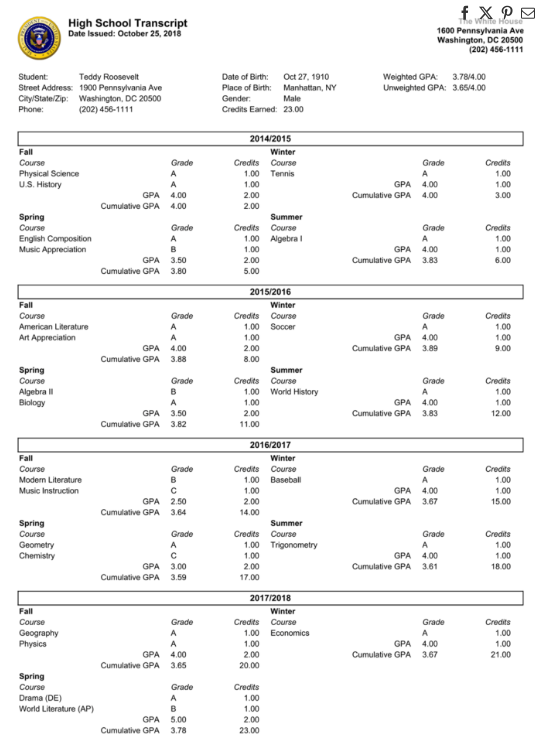
The header contains biographical information. The body of the document shows the specific year and term the classes were taken in and the grade the student achieved. Various Grade-point averages are calculated.
Student Term Records
Student Terms. There is one term record for every term the school operates. A student term record contains student-specific information about how the student performed academically in the term, such as the student's grade point average for that term. All the classes a student takes (enrollment records) are linked to the student term. A student has a term record created for each term they are in attendance.
PEMS develops the information required for the transcript by making a unique record for every grading period (school term) that the student attends the school. A diagram of the data relationship for school terms is shown below:

For each individual student, there are multiple student term records. Each student term record is related to only one (school) term record. However, when all the students are considered, the school term record will be related to multiple student term records, one for each student enrolled in that particular term.
(School) Term Table Example
| Fall 2022 |
| Spring 2023 |
Student Table Example
| Akash |
| Jagdish |
| Ishaan |
Student Term Table Example
| (School) Term | Student | Student Term |
| Fall 2022 | Akash | Fall 2022 Akash |
| Fall 2022 | Jagdish | Fall 2022 Jagdish |
| Fall 2022 | Ishaan | Fall 2022 Ishaan |
| Spring 2023 | Akash | Spring 2023 Akash |
| Spring 2023 | Jagdish | Spring 2023 Jagdish |
| Spring 2023 | Ishaan | Spring 2023 Ishaan |
Enrollments
Students take classes during each term. When a student is enrolled in a class, the record that represents the class that specific student took in that specific term is called the enrollment record. The enrollment record relates the classes a student takes to the student term record. The grades a student achieves, A, B, C, D etc. are recorded in the enrollment records. Class Names, from the related class records appear on the student transcript.

To create the transcript, PEMS creates a report of completed enrollments sorted by student term.
term
|
Terms |
| Fall 2024 |
| Spring 2025 |
student term
|
Term |
Student | student term |
| Fall 2024 |
Akash |
Fall 2024 Akash |
| Spring 2025 |
Akash |
Spring 2025 Akash |
Class List
| Class List |
| English 9A |
| English 9B |
| Indian History 1 |
| Indian History 10 |
| Algebra 1 |
|
Algebra 2 |
Enrollments
| Student Term | Class | At Grade-level (automated-calculation) | Grade (manual entry-Moodle) |
| Fall 2024 Akash |
English 9A |
9 | A |
| Fall 2024 Akash |
Indian History 1 |
9 | B |
| Fall 2024 Akash | Algebra 1 | 9 | A |
| Spring 2025 Akash | English 9B | 9 | C |
| Spring 2025 Akash | Indian History 10 | 9 | A |
| Spring 2025 Akash | Algebra 2 | 9 | F |
Programs of Study Function
Relevant Definitions
Enrollment is the process of signing up for a class. An enrollment record in the PEMS is the class as student takes in a specific term, and stores the student's final grade. The set of completed enrollments is the information displayed on the student's transcript.
Student Terms. There is one term record for every term the school operates. A student term record contains student-specific information about how the student performed academically in the term, such as the student's grade point average for that term. All the classes a student takes (enrollment records) are linked to the student term. A student has a term record created for each term they are in attendance.
Graduation Requirements
Most jurisdictions require students to take a certain number of units and certain types of classes in order to graduate with a degree. These requirements will be collectively called a program of study. Normally, students meet with a counselor, who explains to them the courses they need to take to meet their educational objectives, then it is the student's responsibility to enroll in the courses. The counselor provides oversight and checks the student is on track. This is time intensive and prone to error. In reality, the specific classes a student takes can be pre-determined based on the educational objective.
The image below shows a portion of information generally found on student transcripts:
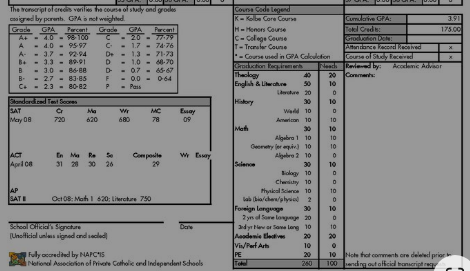
In the graduation requirements block, the units the student has already taken is shown along side the units the student must still take. An unfortunate disadvantage to allowing students to pick their own classes is that they might not meet all the graduation requirements.
Program of Study
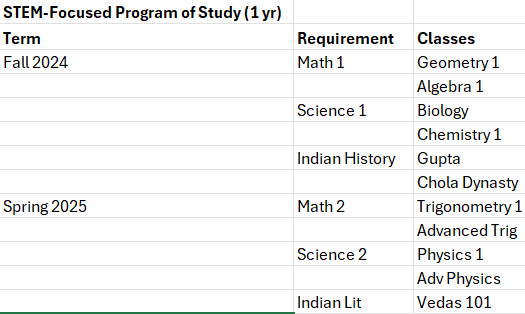
The PEMS was designed to allow administrators to plan out a set of classes (such at Algebra I, World History, English, and so on) that the student will take over a multi-year time frame. Once a student is assigned a plan, there is no need for the student to pick classes every term. The plan itself ensures all requirements and auto-enrollment ensures the student is taking the right courses when they need to. However, plans can be changed and manually adapted as students change their objectives.
The Programs of Study Function provides administrators the ability to pre-plan any number of "programs of study", which are called plans inside of the PEMS. The student can then be assigned a plan, which provides the information needed to auto-enroll the student in classes every term until the plan is complete.
PEMS makes an enrollment record for every required class under the plan, then relates that enrollment record to the future student term records. The status of future enrollments is 'incomplete.' When the student is ready to be enrolled in the class, PEMS auto-enrolls the student in the Moodle Course required for that class. At the end of term, the grade is updated by the course progress in Moodle and if the score is adequate, course credit is granted.
A plan is not just a list of courses required to meet graduation requirements, a plan sets out which class must be taken in which term.
When students are picking and choosing their classes, many technologies are unable to provide an instant assessment on whether the student will complete their graduation requirements. With this approach, at any point in time, a student's enrollment records can be viewed as a whole. And because each record is marked complete/incomplete, one can immediately asses a student's progress towards their academic goals.
In creating a plan instead of picking individual classes, the administrator can ensure that students are meeting their various requirements for graduation. And by enrolling a student in a plan, the administrator ensures the student meets the requirements.
Multiple Plans
There is no limit to the number of plans that may be created. This allows the PEMS to be deployed in a wide variety of educational systems or allow each school to effectively automate a high degree of customization without having to staff counselor roles.
By creating multiple compliant plans, a school can offer a great deal of customization in the program, while ensuring all requirements are met.
Assessment Function
Relevant Definitions
Curriculum generally refers to the books and exercises used by the teacher to further the student's knowledge. In Moodle, the curriculum is a Moodle Course. Any class may be taught with multiple curriculum, or different text books, and so there are multiple Moodle courses that may be used to teach a Class.
The Assessment Function
An assessment checks how a student is performing academically. Assessment in PEMS are used to track how the school's academic program is delivering results. Where many schools simply track the performance level of a student, PEMS tracks performance improvements. PEMS is a system that monitors how the school is functioning in such a way that the school can constantly improve.
Three Contributors to Student Performance
- Curriculum - did the curriculum, or Moodle course, provide a net improvement in academic scores.
- Engagement - did the student complete the course as planned.
- Program - does one set of courses provide better or worse outcomes than another set.
PEMS makes no assumptions about how the three factors above contribute to student academic performance. Certainly these factors are interrelated, a student that engages more in the course will most definitely show greater improvement.
Programs are created in the PEMS as a set of classes the student takes over a few years. Program placement, or the readiness of a student to complete the program is critical to the school's ability to tailor a program to a desired outcome. For example, it is generally believed that taking art classes may stimulate learning in broad areas of study. If this is true, then students will have better program-level outcomes if they are also taking art. Another example is the idea of writing-though-the-curriculum, which is an idea that if a student has writing assignments in every single class, learning outcomes will be superior. If this is true, then a program that focuses on copious writing assignments will produce better results.
Curriculum is created in Moodle and courses may differ in their level of intensity, once course may require more writing, another may only provide auto-graded quizzes. Some classes may have weekly teacher lectures, or weekly teacher check-in sessions. Other classes may require printout and hand writing, or proctored exams. There are a great many differences in curriculum.
Engagement is multifaceted, it includes the grade the student achieved in the course, the total time spent on the course, and how much of the course was completed on time. The environment a student studies in will also affect engagement, does the student do their work largely on campus or at home?
Every school will want to select what assessments matter to their own academic vision. In one school, they may only care about reading comprehension and math levels, in a different school they may prefer to test for spatial reasoning or artistic competence. In selecting what a school tests for, the school is setting the goals that their program will be trying to reach.
Two Assessment Type Metrics
Level Equivalent
Students are assessed for their progress towards acquiring the knowledge and skills of a high school graduate, a student who completed 13 years of schooling. Given enough time and effort, all students can reach this standard. Level equivalent is an approach that assesses if a student is progressing faster or slower towards their graduation. If the student is progressing slower, they are behind their grade level, if the are progressing faster, they are above their grade level. PEMS allows users to define the grade level equivalent for each score. As I understand it, this means that each school head can determine personally what it means to say be at a 6th grade level. Normally, how is the national grade level competency determined. Would most school heads go off a national standard determined by the Department of Education?
PEMS uses hundreds/tens place pattern for its Level Equivalent scoring. The grade level in in the hundred's place, and the month is in the tens place. For example 840 is eight grade 4th month. Withing a grade year, this is a quick visual reference for improvement, 800 compared to 860 represents 6 months of academic progress. Parents and student readily understand this system and it is easy to explain. A student starts a grade at 800, then increased by ten for every month in school. After the ninth month, the student has achieved 890. Then the student takes summer off and starts 9th grade at 900. 890 is the same as 900 under this system. This issue becomes important when calculating grade level differences in grade level achievement in some cases.
Percentile Ranking
Percentile ranking is another method of assessing student performance. With this method, students are ranked against their peers in a larger population, either state-wide or nationally. Traditionally, a student's grade in a course can be considered percentile ranked, for example only 10% of students should receive and A in the class. Percentile Ranked assessments are similar but across a larger population of students. For these types of assessments, PEMS stores a raw score and a percentile rank in the assessment result record.
Competency-Based Standards
Competency based tracking allows students to demonstrate mastery or competency in what they can do. The completion of a end of year essay with a passing grade of an B demonstrates the student can competently write an essay. Competencies may also be used to verify domain knowledge. A student may have a very high level of reading but very little domain knowledge of history for example.
Tracking Competencies allow schools to ensure students meet all their objectives. A student may score very high in reading competency, achieve a B in an English class, but has never turned in a reasonably well written essay. Alternatively, a student may archive a B in History with excellent knowledge of the Roman Empire, but with no domain knowledge of World War II. Good grades may not catch a lack of competency or domain knowledge in areas important the philosophy of the school requires.
When a school develops a competency list, the school is in fact developing their own, independent assessment system. Level Equivalent and Percentile ranking methods of assessment inherently compare the student to the greater world. Competencies are authored by the school itself and reflect the school's own academic standards. When well structured, competency tracking can reduce endless assessment. When a teacher grades an essay at A+, the writing competency is achieved and students do not need to take a writing exam. Regular day-to-day schooling reducing constant testing.
Competency tracking in PEMS is tightly integrated with Moodle. The school will develop a check list of competencies the student should be demonstrating at each grade level or grade span. In order for competency tracking to be effective, the school faces a rather intensive task of tagging activities across all the courses with the competency checklist. When a student passes the activity, they earn the competency.
This whole section is pretty straight-forward and makes sense.
Teacher Certification Function
Certifications
Teacher certifications are complex for any school to track. A teacher may be certified based on the State, subject, or grade level taught. The certification may or may not have an expiration date, and some specific classes may require higher certifications that other classes. Certification records include any process the teacher must go through in order to teach classes. Examples are college degrees, teaching exams, back-ground checks or any other security processes that have an expiration date. It is generally the case that any public funds will not be issued to schools if schools do not ensure teachers are properly certified and those certifications are maintained.
Authorizations
Certifications may be combined to create authorizations and in some cases, one certification may provide multiple authorizations. An authorization is permission to teach a subject or class for a specific grade span. An authorization record is linked to multiple certifications as needed, such as the teacher credential, the Security back-ground check, or the required on-going professional training, so that all the factors that go into 'green-lighting' the teacher to teach that subject are understood.
PEMS tracks teacher authorizations, and provides alerting to expiring credentials which may put the authorization in jeopardy. In this way, the administrator is aware of any concerns with teacher authorizations which can affect legal reporting, accreditation, and funding sources.
This is straightforward and makes sense.
Reference - PEMS Terminology
Letter Mark
Letter Mark. In the US, grades are usually awarded as letters, A, B, C, D and F. There is no grade of E. Other countries use a straight number system with a maximum of ten. It is normal to call letter marks just 'grades' in American English, but this can be confusing as a student's grade is also "kindergarten" or 6th grade. In other countries, this definition of grade is usually called a 'form', like the sixth form. Letter Mark refers the the letter given in the US for overall course scoring.
Grade Points
Grade Points. Because the US uses letter for marks, there needs to be a numerical system in order to determine how the student is doing over all. Grade points are awarded based on the letter grade. For example, 4 points are awarded for an A, 3 for a B, and so on.
Grade Point Average
Grade Point Average (GPA). The Grade Point Average is the unit-weighted average of the student's grades. Each class has a number of units (also called credits) assigned. If a student earns an A in a class worth 5 units, the total points awarded for that class is 5 (units) x 4 (points) = 20 points. For a given term all the points are added, then divided by the total units to arrive at the students GPA. In this example, 20 (total points) / 5 (units) = 4.0 GPA.
Weighted GPA
Weighted GPA. students take more advanced courses, the grade points may be increased. For example, if a student earns a A in an advanced English class of 5 units, the student earns a 5 instead of a 4 for grade points for weighted GPA. The total points for that class is 5 (units) x 5 (points) = 25 points (total). Then divide this by totals (5) for a GPA of 5.0. The higher number of points are used to calculate the student's weighted GPA. Lower number of points (4 instead of 5 points) is used for unweighted GPA.
Academic Years
Academic years are the specific years the school is in operation. Academic years can be defined before the school is in operation. In this case the academic years are used to keep records on classes a student wants to transfer into the school that were taken at other schools prior to enrollment.
Terms
A term is the division of the academic year into grading periods. Terms may be semesters or quarters. The term record is a record that indicates the start and end date of each term. Multiple terms are related to academic years. Terms are also related to a Term Label record.
Term Labels
Term Labels are the names of the terms a school is running, like Spring, Fall, etc. The number of Term Label records indicates the number of terms the school operates. Term Labels indicate if that term is required or optional, like a summer term.
Student Terms
Student Terms. There is one term record for every term the school operates. A student term record contains student-specific information about how the student performed academically in the term, such as the student's grade point average for that term. All the classes a student takes (enrollment records) are linked to the student term. A student has a term record created for each term they are in attendance.
Grade Level
A grade level is the student's year in school, first grade, second grade, third grade and so on. The term 'grade level is used to differentiate between the grade or mark a student received in a class and the year the student is in.
Grade Span
A grade span covers multiple years of school and can be defined by the administrator. A plan can not exceed a grade span. The purpose of defining grade spans is to help set academic goals and gates.
Schools
Schools refer to legal definitions in a jurisdiction of various grade levels. In the US this is Elementary School, grades K through 5, Middle School grades 6 through 8, and high school, grades 9 through 12.
Other Schools
Other Schools are the schools that student attend prior to starting at the school. Other schools will provide transcripts that must in incorporated into the student record. For this reason, each enrollment record on the transcript may be related to an 'other school' to show where the credit was transferred in from.
Classes
Classes. The name of the Class appears on the student's transcript. Classes are sometimes called courses. However, PEMS does not use the term 'course' in any of its modules. In general, the word 'course' can refer to a specific class, like Algebra 1, or it may also refer to the set of classes that lead to a degree or certificate. For example, "I followed a course at the University in wine making" could mean a series of classes. The world "class" also has a secondary meaning. A student can be in the "second grade class" which would mean all students in a particular classroom. PEMS uses the word class to mean the subject of study for which units are earned, commonly called a course, such as "Algebra I". A class that is a subject of study for units can have different curriculum that fulfill it.
Sections
In real life, Sections are a set of students taking a particular class. In a standard brick and mortar school, a sections are like the physical classroom. There may be multiple teachers teaching English 9 in a school, each with their own physical classroom number. There are no traditional sections in the PEMS universe since there is no needs to physically separate students into various classrooms. However, students from multiple learning locations can all be enrolled in the same Moodle Course, and only their own teacher should see their work. So PEMS uses the term groups to refer to a set of students assigned to a specific teacher. In Summary: 1) PEMS does not use the term sections. 2) Instead Moodle uses the term (virtual) groups.
Sections: More important in traditional school as it meant multiple classrooms but same subject. In virtual school, the concept of sections is no longer applicable and groups is used instead.
Groups: Students taking different classes on Moodle, but have the same teacher? Is this is right conception of groups?
Curriculum
Curriculum generally refers to the books and exercises used by the teacher to further the student's knowledge. In Moodle, the curriculum is a Moodle Course. Any class may be taught with multiple curriculum, or different text books, and so there are multiple Moodle courses that may be used to teach a Class.
Course
The term Course is not used in any technical sense in PEMS. Courses are created on the LMS (Moodle) platform for students to take online, but PEMS refers to courses as curriculum. For example, two different English teachers could be teaching English 9, but they assign different books to read. The class is the same as far as the school is concerned, the the material and activities the students turn in are slightly different, the classes use a different curriculum. If the teachers were making their own online courses, the activities would not be the same. Classes may use different Moodle courses to fulfill learning requirements, as they may use different curriculum.
Syllabus
The Syllabus is the outline of what a student will learn in the class our Moodle course. Usually this is handed out the first day of class and informs the students of the learning objectives. In the US, the course syllabus must be submitted to various regulatory organizations to gain approval. In PEMS, the class may have one syllabus, and the Moodle course may have a tailored syllabus for the specific curriculum. The administrator my use both or select one approach.
Subject
Subjects are families of classes. For example, Algebra I, Geometry, and Algebra II are all in the subject of Math. Schools can define any subjects they need, and identify any class as belonging to that subject area. Subjects are mainly used to assist the administration in checking the student is meeting requirements when creating a plan .
| Subject | Class | Course/ Curriculum |
| Indian Literature | Vedas 1A | Samhitas |
| Indian Literature | Vedas 1A | Brahmanas |
Teacher of Record
The Teacher of Record is the 'official teacher' of the student for a specific class, or for multiple classes. Various regulatory agencies require the teach of record to be in possession of certifications and credentials. PEMS is designed for virtual schools and so all Teachers of Record are virtual teachers. The teacher of record is legally responsible to give the student their grades.
Would we require all customers have their teachers be subject to regulatory certifications and credentials that traditional school teachers are subject to?
Enrollment
The term enrollment has two meanings in the USA.
- Enrollment is used to describe the process where a student joins the school
- Enrollment is also used to describe when a student enrolls in a specific class in a specific term
The term "Enrollment Process" will refer to the processes that are triggered with a student decides to come to the school.
The term "enrollments records" will describe the table in the database the keeps information of which classes students are taking in which term.
Enrollment is the process of signing up for a class. An enrollment record in the PEMS is the class as student takes in a specific term, and stores the student's final grade. The set of completed enrollments is the information displayed on the student's transcript.
Transcript
A transcript is a report of completed enrollments. Transcripts are formatted in various ways to use the minimum amount of paper. A transcript shows the classes the student has taken at the school, the grades received and the units earned.
Plans
The plans are sometimes referred to as "Programs of Study." Plans are defined by the administrator as a series of classes taken across all subjects to meet an educational objective or graduation requirements over a grade span. Any number of plans may be developed, and a student may be assigned only one plan at a time. The plan contains the information needed to auto-enroll student in their classes (create enrollment records) in each term covered by the plan.
Plans cannot go past a grade span and a grade span is determined by the administrator.
Templates
Templates are records that specify the sequence of classes to be taken under the plan. One plan will have multiple templates associated to that plan, each representing a class that must be taken to meet the plan's requirements. A template is a model of a student enrollment record. A template record specifies the class name, the corresponding curriculum, and the term the course should be taken in. PEMS copies all the template records associated with the student's plan to create the enrollment records for that plan. Enrollment records are copies of the template records that are associated with a specific student term (who and when).
As I understand it, a student plan can have multiple templates for various ways to achieve that plan? A student plant may have English and Math as a requirement while templates will have the sequences of classes (i.e. Old English, Shakespeare, Kipling) all required to meet the English portion of the plan?
Subject Requirements
Subject requirements are the number of units in total required in a subject area by a regulatory organization. For example, the NCAA may require 4 years of English and 3 years of math. The University of California may require 4 years of English and 4 years of math. The NCAA subject requirement for math is 3 years, the University of California subject requirement for math is 4 years. For University of California, the subject requirement is 4 years, the subject is math. Note: sometimes requirements are described in 'years' of study, sometimes in credits, and sometimes in units.
Subject requirements of different collegiate organizations are important for students who wish to qualify for those colleges and/or certain activities like collegiate athletics or a conservatory.
Compliance Tags
Compliance tags are used to help manage the different requirements of the various regulatory organizations. Not only do the regulatory organizations specify the subject requirements, they also must each approve the course description (syllabus). Students are not allowed to meet the subject requirements with any curriculum, they must meet the requirements with curriculum that has been submitted and approved to the organizations. The student's transcript must then show that the class & curriculum has been approved by the various regulatory organizations. So compliance is a property of the Moodle Course. The Moodle Course list in PEMS is called the curriculum table. There is one record in the curriculum table for each course available in Moodle. PEMS lets the administrator tag certain curriculum records with a compliance tag. If a student takes a class, English 9A, and is enrolled in a specific curriculum, or Moodle Course, the compliance tag from the associated Moodle course will appear on the transcript. Compliance tags are deliberately short to fit on the transcript pages.
Compliance tags populate on transcripts to show what collegiate regulatory body requirements the class has met.
Reference - Moodle Terminology
General Moodle Terminology
Moodle Activity - DLP
A Moodle activity is basically an assignment give to a student where the student receives a grade upon completion. The Moodle "grade book" lists the students scores on all activities.
| Moodle Activity | Gradebook |
| Algebra HW 1 | 100 (A+) |
| Algebra Quiz 1 | 90 (A-) |
Studia Nova refers to an activity as a DLP (Daily Learning Plan) because all activities are developed to be completed in a one-day assginement.
Moodle Course Organization
Moodle Course ID
Moodle Course ID is a unique value assigned to each course developed in Moodle. Any actions triggered between the SIS and Moodle require matching on the Moodle Course ID. In PEMS the Moodle Course ID is stored in the Curriculum table "Code" field.
Moodle Category
Courses are organized into categories in Moodle. Moodle can perform various batch functions on all courses within a category.
Moodle Student Groups
Moodle Groups
In Moodle, Groups are used to break up groups of students enrolled in a course. Moodle can enroll hundreds of students in one course, but the teacher would be overwhelmed to grade all the work. Therefore Moodle provides the group option. When teachers and their students are enrolled in the same group, the teacher only sees their own students. In PEMS, Moodle groups are used to block teachers from seeing students that belong to a different location. However, Moodel groups are not defined at the system level in Moodle, they must be defined in each and every course. In Summary: 1) Moodle uses Groups to hide students enrolled in the same course from other teachers. 2) Both the teacher and the student have to be in the same group. 3) Groups MUST be defined for each and every course, Groups can not be defined at the system level.
| Student | Teacher | Course | Group |
| Akash Singh | Gandhi | Indian Literature 1A | 1 |
| Jagdish Singh | Gandhi | Indian Literature 1A | 1 |
| Ishaan Vaidya | Nehru | Indian Literature 1A | 2 |
| Vivek Rao | Nehru | Indian Literature 1A | 2 |
The groups must be done manually in the course
Moodle Cohorts
In real life, a cohort is a set of students at a specific grade level. All ninth graders in 2023 form a set of students, as they move through the various grade levels, we refer to those 2024 ninth graders as a cohort. In Moodle a cohort is a set of students and a teacher(s). Cohorts are primarily used in Moodle for batch enrollment. For the use case that all students in 4th grade should be enrolled in 4th grade math. In this case a Moodle user would define a cohort of 4th graders, then assign the cohort to a specific course. However, using cohorts for enrollment is not useful in PEMS because each student is following a unique program. The unique program is managed in the SIS. In PEMS, all fourth graders are not enrolled in fourth grade math. However, cohorts are still useful for reporting. So in PEMS, Moodle Cohorts are used to identify a set of students under the supervision of a particular teacher (proctor). In this use case, students can be at any grade level since PEMS is designed for mixed grade-level student management. Unfortunately, Moodle Cohorts can not be used to block a teacher from seeing other student's work who are not in their own cohort. In summary 1) Moodle Cohorts are a set of students and their teachers (proctors) 2) the students in the set can be any grade level 3) Cohorts are useful for reporting 4) All teachers can see all students in any cohort.
All students in one schoolhouse are in a cohort. What is the difference between a group and a cohort? Aren't they both just ways to delineate all the students under a particular teacher?
Moodle Competency Tracking
Moodle Competencies
Moodle competencies are specified in the activity settings, internal to a Moodle course by the course creator. Each activity may be tagged with pre-defined competencies. When the student completes the activity, they earn the competency. The competency list is created in the admin panel.
In the Moodle Competency record, the ID number field uniquely identifies the competency. This field is used for integration with the SIS for tracking competency completion.
Moodle Competency Frameworks
Moodle Competency Frameworks are defined in the admin panel of Moodle. A framework is used only to organize the competencies and flow down settings. A framework can not be assigned to a student, each competency must be added to a template, then that template assigned to a student.
Isn't a template a sequence of courses that fulfill a specific requirement of a plan? I assume based on the above, it includes a list of competencies as well?
Moodle Learning Plans
In Moodle, a student can be assigned a learning plan, which is a group of competencies that may span multiple courses. The student can view their progress towards the learning plan in their profile.
Learning plan includes competencies and classes? Or is this different from student plan?
Moodle Learning Plan Templates
Moodle allows the admin to define Learning Plans, which are sets of competencies. Learning Plan templates are use to assign learning plans in bulk to students. Templates may be assigned to a Cohort of students.
This sounds like learning plan templates are different than student plan templates. Did I understand that correctly?
Platform Strategy

School-In-A-Box
Word Press - Website pre-configured website for online enrollment ans tuition payment.
SuiteCRM - CRM rto drive business and manage communication, contract and documentation workflow.
Asterix PBX - dial from CRM, inter office phone numbers (TBD)
Moodle - LMS pre-configured with all Studia Nova classes, third party subscriptions priced separately but bundled with the solution.
PEMS - fully integrated with Moodle for student Information management.
BookStack App - Pre-configured with required academic documentation for approvals (course syllabus) etc, shared book with master for technical documentation. Accreditation Work Flows, sample contract etc. With custom formatted export from HTML
Keycloak single sign on.
Hosted Solution - IONOS hosted solution, not a customer onsite deployed solution. Includes back ups and email.
Next Cloud - and Only Office - online files and productivity
Accounting System - TBD, multiple open source accounting systems will be evaluated.