Module Overview
Relevant Definitions
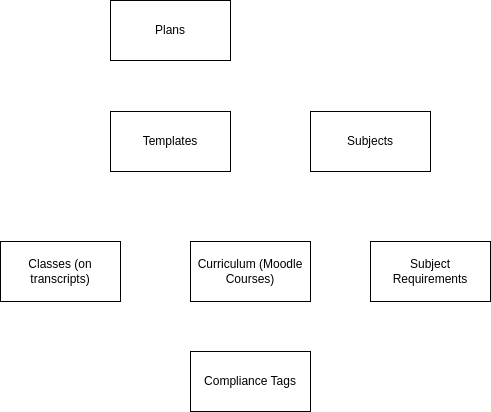
Classes. The name of the Class appears on the student's transcript. Classes are sometimes called courses. However, PEMS does not use the term 'course' in any of its modules. In general, the word 'course' can refer to a specific class, like Algebra 1, or it may also refer to the set of classes that lead to a degree or certificate. For example, "I followed a course at the University in wine making" could mean a series of classes. The world "class" also has a secondary meaning. A student can be in the "second grade class" which would mean all students in a particular classroom. PEMS uses the word class to mean the subject of study for which units are earned, commonly called a course, such as "Algebra I". A class that is a subject of study for units can have different curriculum that fulfill it.
Curriculum generally refers to the books and exercises used by the teacher to further the student's knowledge. In Moodle, the curriculum is a Moodle Course. Any class may be taught with multiple curriculum, or different text books, and so there are multiple Moodle courses that may be used to teach a Class.
Subjects are families of classes. For example, Algebra I, Geometry, and Algebra II are all in the subject of Math. Schools can define any subjects they need, and identify any class as belonging to that subject area. Subjects are mainly used to assist the administration in checking the student is meeting requirements when creating a plan .
A transcript is a report of completed enrollments. Transcripts are formatted in various ways to use the minimum amount of paper. A transcript shows the classes the student has taken at the school, the grades received and the units earned.
The plans are sometimes referred to as "Programs of Study." Plans are defined by the administrator as a series of classes taken across all subjects to meet an educational objective or graduation requirements over a grade span. Any number of plans may be developed, and a student may be assigned only one plan at a time. The plan contains the information needed to auto-enroll student in their classes (create enrollment records) in each term covered by the plan.
Specific Definitions for the Programs of Study Module
Subject Requirements
Subject requirements are the number of units in total required in a subject area by a regulatory organization. For example, the NCAA may require 4 years of English and 3 years of math. The University of California may require 4 years of English and 4 years of math. The NCAA subject requirement for math is 3 years, the University of California subject requirement for math is 4 years. For University of California, the subject requirement is 4 years, the subject is math. Note: sometimes requirements are described in 'years' of study, sometimes in credits, and sometimes in units.
Compliance Tags
Not only do the regulatory organizations specify the subject requirements, they also must each approve the course description (syllabus). Students are not allowed to meet the subject requirements with any curriculum, they must meet the requirements with curriculum that has been submitted and approved to the organizations. The student's transcript must then show that the class & curriculum has been approved by the various regulatory organizations. So compliance is a property of the Moodle Course. The Moodle Course list in PEMS is called the curriculum table. There is one record in the curriculum table for each course available in Moodle. PEMS lets the administrator tag certain curriculum records with a compliance tag. If a student takes a class, English 9A, and is enrolled in a specific curriculum, or Moodle Course, the compliance tag from the associated Moodle course will appear on the transcript. Compliance tags are deliberately short to fit on the transcript pages.
Data Relationships