
Sequence Adapted Learning
Sequence Adapted Learning (SAL) is a method of ensuring that students follow the school's defined scope and sequence of curricula while addressing the widely variable capabilities of each student.
SAL differs from personalized learning in that the student follows the scope and sequence that is the hallmark of the school itself, there are no student-directed education choices. SAL also differs from personalized learning in that there is no focus on differing learning styles. Students are expected to learn the material as developed and identified by the school. However, SAL does address learning gaps at its core, so in this understanding of personalized education, SAL is indeed personalized.
SAL requires a mastery approach in the core competencies required to continue up the education ladder. Fundamentals are advanced according to the school's sequence of learning. However, SAL does not tie competencies strictly to grade level, so students may progress in grade levels but still progress logically through the sequence of competency. SAL establishes periodic gates in a student's academic development where core competencies must be evidenced in order to proceed to more challenging courses.
Regarding project-based learning, SAL really does not address this concept, but does not preclude it. Further, SAL does not address Social-Emotional Learning, except in its outstanding ability to achieve excellent academic outcomes, which produces happier, less anxious, and more confident students without the therapy training.
Readiness
If we are designing a great system of education, we must know what problem we are trying to solve.
The main challenge to getting all students to achieve is not really their differing learning styles, it is mainly that we assign students material mostly based on how old they are, not how ready they are for that material. SAL treats readiness as the primary driver of student achievement outcomes.
Consider a group of high school freshmen planning to take Algebra 1. If a school gives an Algebra readiness exam, they would not be surprised to find a small set of students are actually ready to take Algebra, many almost ready, and most with out a basic understanding of arithmetic. It is no mystery to the Algebra teacher who is going to fail the class after the first week of school.
No student is bad at math, but most students are not ready for the math class they are taking. SAL does not assign courses to students who do not have the fundamentals to be successful in those courses.
Rate and Dedication
Some students are more dedicated than other students, some put in the time into their studies, others less so. If a student is ready for the course, the time a student puts into a course drives the outcome of that course more that any other factor. If a student is not putting in the time, the student will not get to the competency level needed for the next course in the same amount of time as the diligent student. For this reason, a mastery based learning system must be flexible in the time allotted to a student to complete a course.
Additionally, many students have complex medical issues which reduce the total amount of time they can spend on a course. These students not only face the challenge of their medical problems, they also get penalized academically.
If all students are required to complete the same course in the same amount of time, the whole purpose of mastery-based learning is defeated for that student who did not complete the course in the time allotted.
Computer-Based Learning
There is no practical way to ensure readiness, gap learning, and rate flexibility without computer-based learning. Traditional classroom-based teaching can in no way adapt to the highly-varied readiness of incoming students, nor provide flexibility in the rate of completion of the learning material. SAL effectively uses computer based learning for assessment, placement, individualized gap learning and completion rate flexibility.
The Feed Back Loop
SAL establishes a feedback loop that incorporates administration, transcripts, curricula and assessment data and processes to achieve consistent educational outcomes.
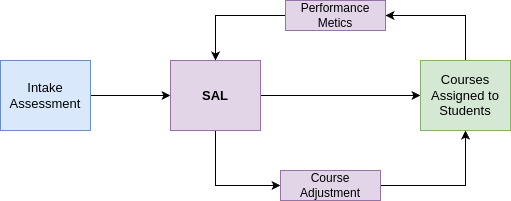
This feedback loop is common to all engineered systems, and is sometimes referred to as "continuous improvement," in the context of business processes. The information obtained from the assessments is used to directly modify the learning experience of the students, in total contrast to how assessment data is more commonly used, to give a school's report card.
Traditional Open Loop Education
Traditional education does not adapt the student's learning experience to the capability and dedication of the student. The material is assigned and the outcomes recorded.
