
The SAL Feed Back Loop
Traditional Open Loop Education
Traditional education does not adapt the student's learning experience to the capabilities and dedication of the student. The material is assigned and the outcomes recorded.

When all third graders are assigned the school's standard third grade curricula, the classes a student takes is solely based on the age of the student. The outcome of the class is recorded by the teacher in the grade the student receives. As long as the student skates by with a D, the student will progress to the next grade level, in many cases learning very little.
At the end of the year, or close to the end of the term, schools conduct assessment testing. The assessment testing is meant to help the school improve it academic outcomes by measuring student success. However there is no way to adjust any aspect of an individual student's learning experience based on these aggregate assessments; only rarely is there a specific decision made on behalf of a student based on these assessments.
In a traditional approach, schools do assessments to tell the community how their students are performing. The idea that assessments can be used to change a student's learning experience is not widely implemented in practice.
The Feed Back Loop
SAL establishes a feedback loop that incorporates administration, transcripts, credits, curricula and assessment data and processes to achieve consistent educational outcomes.
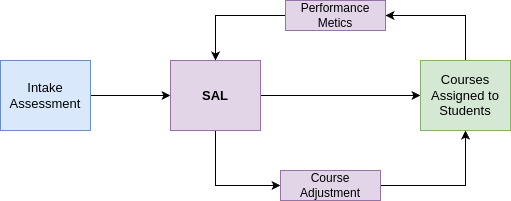
This type of feedback loop is common to all engineered systems, and is sometimes referred to as "continuous improvement" in the context of business processes. The information obtained from an assessment is directly used to modify the learning experience of the students, in complete contrast to how assessment data is more commonly used, to give a school's report card.
For the feedback loop to operate, the assessment of the student must be first completed before placing a student in any course. For student's transferring mid-term, as is quite common, the school can not rely on 'assessment week,' and so assessment must be a key element of the student intake process at any time the school accepts new enrollment.
Challenges
Implementing an intake assessment increases the administrative handling of a new student, and potentially the cost. The SAL feedback loop injects a decision point into the process prior to class enrollment. Normally, prior to class enrollment, student processing is purely business administrative, checking the forms are complete, checking fees are paid if private, requesting prior school records, and so on.
SAL requires a decision to be made for each individual student on the most appropriate academic program, and so it must facilitate integrating people with educational programmatic expertise into the process.
No Comments