
Classes Table
Relevant Definitions
Subjects are families of classes. For example, Algebra I, Geometry, and Algebra II are all in the subject of Math. Schools can define any subjects they need, and identify any class as belonging to that subject area. Subjects are mainly used to assist the administration in checking the student is meeting requirements when creating a plan .
A grade span covers multiple years of school and can be defined by the administrator. A plan can not exceed a grade span. The purpose of defining grade spans is to help set academic goals and gates.
Enrollment is the process of signing up for a class. An enrollment record in the PEMS is the class as student takes in a specific term, and stores the student's final grade. The set of completed enrollments is the information displayed on the student's transcript.
Curriculum generally refers to the books and exercises used by the teacher to further the student's knowledge. In Moodle, the curriculum is a Moodle Course. Any class may be taught with multiple curriculum, or different text books, and so there are multiple Moodle courses that may be used to teach a Class.
Classes. The name of the Class appears on the student's transcript. Classes are sometimes called courses. However, PEMS does not use the term 'course' in any of its modules. In general, the word 'course' can refer to a specific class, like Algebra 1, or it may also refer to the set of classes that lead to a degree or certificate. For example, "I followed a course at the University in wine making" could mean a series of classes. The world "class" also has a secondary meaning. A student can be in the "second grade class" which would mean all students in a particular classroom. PEMS uses the word class to mean the subject of study for which units are earned, commonly called a course, such as "Algebra I". A class that is a subject of study for units can have different curriculum that fulfill it.
The Class List
The class list is a set of records that represent all the 'transcript' classes a student will take at the school. The names of the classes are the exact names that appear on the student's transcript.
Data Relationships
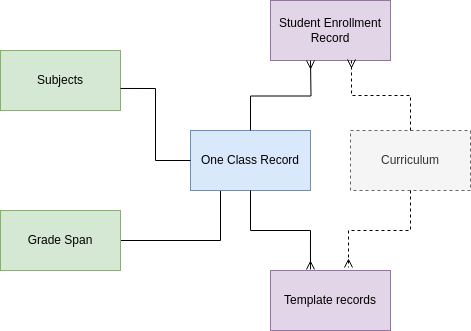
Classes are linked to multiple enrollment records.
As many students will take the same class, many student enrollment records are associated to the same class record. A list of all students who ever took that class may be reported on.
Classes are linked to multiple template records.
1) there may be multiple curriculum (Moodle Courses) that will have all the same name on the transcript, such as two different Algebra I courses using different curriculum, but essential both just Algebra.
2) There will be multiple plans that all required the same class. For example the University preparation will require English 9, but so with the basic diploma.
Each class may only have one assigned subject. Some classes can be dual purpose, this use case is is described in Subject and Subject Requirements Tables.
For example, Environmental Science may be frequently used to meet the Biological Science requirement or the Physical Science requirement, but not both. There would be two class records. One called Environmental Science that is linked to the subject of biology and another that is linked to the subject of physical science. However there is just one Moodle course, so there is just one curriculum record. The curriculum therefore does not specify a subject, and is not related to subject records.
A class record may be associated to only one subject record.
Per above, should a class fulfill multiple subject requirements, separate class records must be created.
Classes are not associated to Curriculum
In the use case above, we see why the classes are not directly associated with the curriculum. Either the template or the enrollment record contains the additional information needed to determine which requirements the combination of class and curriculum fulfill.
A class record may be associate to one grade span.
This feature may be used to filter and down select the relationships when creating the records. Additional logic may be added to prevent students from being enrolled in classes outside their gran span, but this feature has not yet been determined necessary.
Fields
The class name is the name of the course exactly as it is to appear on transcripts.
The units the school gives for the class in only stored in the class record. There are no units associated with the various curriculum (Moodle Courses).
NCES, State, and Local code - these are various Class coding systems used by various regulatory organizations. The local code is used for all school business, the NCES and State codes are informational.
NCES rigor is a specific requirement for hte NCES organization in the US. It specifies the difficulty level of the class.
Syllabus - a field is provided so that the administrator can link an official syllabus to the class.
This Pre-requisite field reserved to add logic to prevent enrollments to be created where courses are out of sync. This is not needed when plans are enables since the planning processes specifies the order.
Carnegie units - this is an alternate unit system used in the US based on the number of hours of the course.
Exclude GPA - this field is a flag to exempt the class from various GPA calculations. The administrator may choose to exempt the Class from the standard GPA calculation, an alternate GPS calculation, both, or neither. The use case for this is that the State of Claifornia's student financial aid organization does not consider Physical Education when calculating the student's GPA for the purpose of student loans.
Action Items JAN 2024
1-MVP | TRANSCRIPT | Victoria to tag all correct classes with the exclude GPA field so that this function may be included in the GPA calculations. DONE
No Comments